Retail Change: how to be innovative to add value
- Kendal Ann

- May 14, 2020
- 8 min read
Updated: May 19, 2020
In today's market, the businesses that focus on the idea of innovation are succeeding in adapting to constant changes. Innovation is essential and provides the opportunity to grow in ways that may have not been seen as possible. Retail leaders such as Amazon and Alibaba are leaders in the industry as well as leaders in the innovation market. By adopting innovative strategies, brands can implement changes in their business model that show positive results and growth.
The following magazine article is the condensed version of my master's thesis on Implementing Innovative Change in Retail Environments.
Currently, there are mixed reports on the status of the retail industry with some reports forecasting a “retail apocalypse” [7] and others stating that the industry is experiencing year-over-year growth [8]. The United States National Retail Federation claims that consumer spending is better than previous year expectations, and the NRF predicts that retail sales within the US will grow by 3.8-4.4% in 2019 [9]. Comparably, reports claim Australia’s retail industry has experienced 2.5% growth over last year in 2019 [3].
While growth within the category is occurring, the department store and specialty softgoods market is downsizing with a staggering amount of store closures [7]. Retailers within these categories did not adapt to changes in the market, and they, themselves, did not implement the necessary changes within their business to remain competitive.
Study Findings
To better understand how retailers can implement innovative change within their business, a qualitative research study involving industry experts has been conducted. Objectives include understanding how innovation has changed the industry, what type of change management techniques lead to success, and if innovative change management (ICM) applies to the retail business model (RBM).

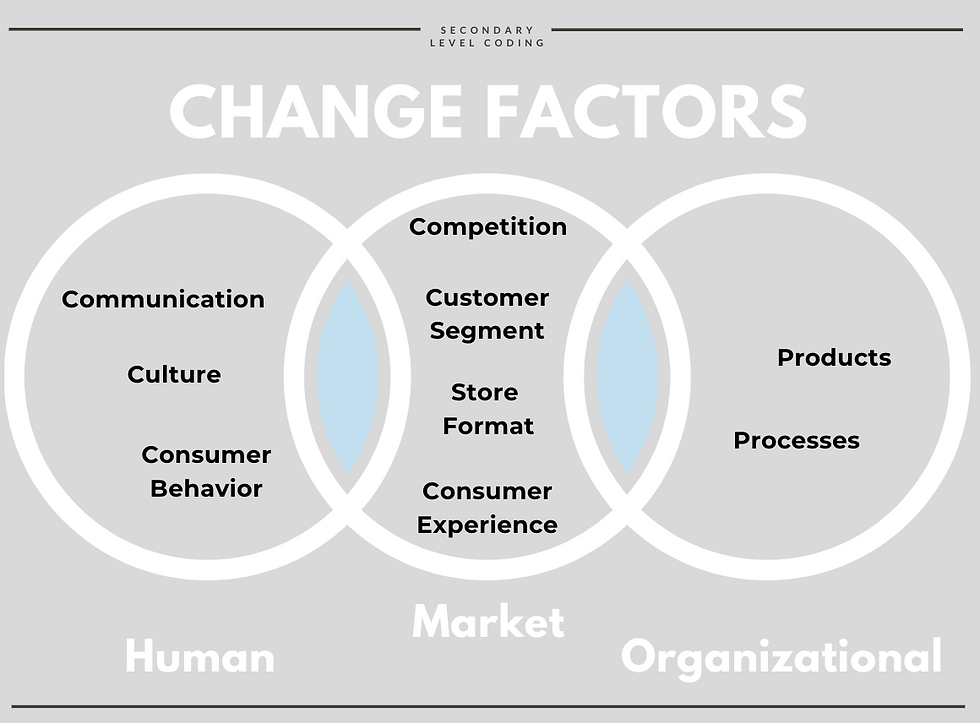
Through a semi-structured interview process, experts presented their views and experiences in dealing with change, change management, innovation, and project management. Primary data coding revealed nine central themes found throughout the data, as shown in Figure 1. Secondary coding categorized themes found into three fundamental aspects of change within retail, as shown in Figure 2.
Innovation
Through data analysis, it has been found innovation has changed the retail industry in two ways: product innovation and process innovation. As products and processes are significant parts of the organization and business model, it can be inferred retailers implement innovative change in these two areas at varying degrees over time. Innovation can either be the creation of new products and processes that a firm introduces to the market, or adoption of new, innovative products and processes from other retailers by individual firms. Innovation occurs at different levels, and what may be innovative for one firm may not be innovative for another, and vice versa.

It is recommended for retail organizations to remain involved with the market to get first access to products and information about innovations. Additionally, for the implementation of innovations to succeed, the impact to internal and external customers should be examined. Innovation is meant to add value to customers, and if the introduction of something new has the reverse effect, the organization runs the risk of losing value.
Human and Market Changes
The introduction of innovative products and processes heavily rely on human involvement and interaction with the market. Both of these aspects can negatively impact project success. Both human involvement and market information affects change implementation, there is an increased likelihood of project success.
The culture within an organization forms over time, and the introduction of change, whether it is innovative or not, may cause negative morale. Through understanding the culture and how change should best be implemented, the likelihood of the adoption of new innovative changes will increase. In addition to culture, investigation into consumer behavior should occur before implementation. Consumer behavior will dictate product requests and influence the purchase of goods. These tasks change what items retailers are buying, replenishing, and merchandising. If retailers want to introduce a product or process that is innovative, they must first understand the consumer behavior of their target market. Communication must be facilitated between employees, who make up the company culture, and with the customers, who determine consumer behavior. Various forms of communication should be used before, during, and after change implementation.
Store format, competition, customer segment, and consumer experience are all market factors that continuously change. They are also sources for innovation, e.g., the Apple store experience and format. Retailers can source innovative ideas to implement within their business, or they may be a source of innovation for the market.
Product Management
Retailing buying and planning are vital departments within the retail business model. These two roles focus on the control, coordination, and facilitation of merchandise through the firm’s value chain. Retail buyers, specifically, are responsible for the sourcing, purchasing, pricing, and merchandising of goods [5].
In comparison, the process of product management places products as the center point of all business decisions, structure, and strategies. The role of the product manager is to ensure the success of the product(s) within the business portfolio by monitoring all phases of the product lifecycle [4].
The duties and responsibilities of retail buyers closely parallel those of product managers, and professionals within the retail industry could benefit from adopting tools and techniques utilized by product managers.
Change Management
Change management, or project change management, is the process of minimizing stress and time lost by managing a specific set of tools, knowledge, and resources to conduct change [6]. Change can come in many forms, and there are varying drivers to change.
In relation to the retail industry, the three major factors identified in Figure 2 are areas firms can change within their organization to implement innovative change. Additionally, these areas may be a source of disruptive change if external sources force the change.
One of the objectives of this study is to identify what change techniques are successful within the retail industry. Through analysis, not one method to change is best. Experts emphasized the importance of balancing formal and informal communication strategies. One expert presented the idea of change advocates and peer-to-peer communication in order to introduce the concept of future organization-wide change successfully.
Application to Theory
Harrington outlines the practice of ICM as a combination of project change management and culture change management [6]. As a results-driven framework, ICM orients change around company culture, business structure, and organizational systems and processes [6]. When using ICM, the four critical factors to success are people, processes, knowledge, and technology [6].
The theory behind the retail industry supports the RBM. The generic RBM focuses on retailing activities, retailing format, and retailing governance, and the model illustrates how these three factors form a system of integrated parts that rely on each other [10]. Aspects found within the RBM do not apply to other industries due to the specialized nature of retailing activities.
Findings from this study, as shown in Figure 2, support the theory of ICM. The human, market, and organizational factors identified in this study align with the culture, structure, and systems and processes Harrington identifies as orientations for innovative change.
Harrington’s model of ICM can be applied to the RBM to fulfill innovative change implementation. As shown in Figure 4, aspects of innovative change align with the three elements of the RBM.

Innovative change management can be used to change the retailing format, introduce robotics in warehouses to change roles within the retailing governance, or through the adoption of auto-replenishment technology during retailing activities. The ecosystem of the RBM requires the application of change to all areas of the business. There is a risk of project failure and increased negative company culture if a change is not discussed concerning all areas of the business. Results from such decisions include loss of market position, downsizing, and store closures.
Design Thinking as a Change Process
Design thinking is recommended as a change process to be used as support when implementing ICM to the retail business model.
Some current innovations within the retail industry have resulted from co-creation with consumers. By including consumers during design, feedback is gained on how to improve products and processes before launch. This idea of co-creation is an essential aspect of design thinking.
Design thinking is a process that puts humans at the center in order to find innovative solutions to complex problems [2]. The method utilizes prototyping and the facilitation of user feedback to align customer needs with innovative solutions [2].
The purpose and process of design thinking incorporate aspects of product and change management. Like product management, design thinking focuses on producing the best solutions to problems found associated with goods and services. The product manager’s goal is to manage, develop, and market product lines successfully. Product managers, and therefore retail buyers, should incorporate the design thinking practice to increase the likelihood that their products will serve their customers’ needs.
Design thinking results in new products/services or solutions to current product/service offerings. In both of these scenarios, change occurs. Pairing design thinking with change management will result in a seamless integration of innovative products and solutions. Retailers can benefit from having design thinking as a tool within their change management practice since the retailer’s goal is to provide value to internal and external customers. In other words, retailers who utilize human-centered design will be sources of innovative products and services.
Conclusion
While reports have negatively presented the state of the retail industry in both the United States and Australia, the industry is experiencing an evolution. The implementation of innovative change will allow retailers to continue business and evolve alongside the industry.
Innovation is the introduction of something new and different that adds value to the firm. Retailers experience innovation at varying degrees, and innovation will continue to impact the industry. Expert opinions suggest that the products retailers carry and the processes they utilize to complete retailing activities are the two aspects of the business that experience the most innovation.
The introduction of innovation causes retailers to experience change. Through interviewing six industry experts, human, market, and organizational factors have been determined as the most influential aspects of change within retail.
By applying the theory of ICM to the RBM, retailers can identify what areas to apply innovative change. The factors discovered in the study either can serve as drivers of change or define areas where change is needed.
As an ecosystem, the RBM focuses on retailing activities, retailing format, and retailing governance. These three areas balance off each other and adapt to changes. When implementing innovative change within retail environments, it is essential retailers understand their RBM to enact and react to changes either caused by the firm or the market.

Suggestions include incorporating design thinking as a change process for the retailing industry. As a process that is human-centered and strives to find innovative solutions to complex issues, design thinking aligns with the goals of retail buyers and product managers. By utilizing design thinking, innovative change will add value to internal and external customers’ needs.
In conclusion, this study has provided supporting evidence to the already existing literature. When implementing innovation change in retail environments, it is recommended retailers utilize change and product management tools, adopt a design thinking approach, and define their RBM.
Further Research
Areas of further research include exploring how different generations have changed consumer behavior and buying power. New generations have caused significant changes to the industry, and the change will only continue. By gaining an in-depth understanding of the buying power of this generation, retailers can determine what types of innovative change is best for their business.
Additional further research is suggested on change models. There are multiple change models present in the literature, e.g., Mckinsey 7S or Kotter’s 8 Step Model, and it would be beneficial to understand how these models can be applied to the retail industry and if they contribute to the successful implementation of innovative change.
References:
[1] Bartel, C., & Garud, R. (2009). The role of narratives in sustaining organizational Innovation. Organization Science, 20(1), 107–117. https://doi.org/10.1287/orsc.1080.0372
[2] Brown, T. (2008). Design thinking. Harvard Business Review, 86(6), 84–92, 141.
[3] Chau, David. (2019, November 4). Retail slumps to “weakest” level since 1990s recession as tax cuts fail to stimulate consumer spending. ABC Premium News. Retrieved from https://search.proquest.com/docview/2311739583
[4] Ebert, C. (2007). The impacts of software product management. The Journal of Systems & Software, 80(6), 850–861. https://doi.org/10.1016/j.jss.2006.09.017
[5] Goworek, H. (2014). An investigation into retail buying roles and responsibilities for own-label clothing: a multiple case-study. The Journal of The Textile Institute, 105(7), 760–769. https://doi.org/10.1080/00405000.2013.848046
[6] Harrington, H. J. (2018). Innovative change management (icm): Preparing your organization for the new innovative culture. Retrieved from https://ebookcentral.proquest.com
[7] Holman & Buzek (2019). Retail’s renaissance, the true story of store openings/closings. [online]. IHL Group Report. August 2019. Available at: https://www.ihlservices.com/product/retails-renaissance/
[8] Kleinhenz, J. (2019). Monthly economic review: November 2019. Retrieved from https://nrf.com/research/monthly-economic-review-november-2019.


Comments